
AI Governance Is Entering Its Enforcement Era
Why 2026 Is the Year Enterprises Must Move From Policy to Runtime Control
For the past two years, nearly every enterprise has developed some form of AI governance policy.
Organizations created acceptable use guidelines. They established review committees. They drafted model risk management frameworks. They added AI sections to security policies.
And for a while, that felt like progress.
But as we move through 2026, it has become increasingly clear that policy alone is not governance.
The reality many security leaders are discovering is that most organizations have governance documents — but very few have governance controls.
That gap is becoming impossible to ignore.
The AI Governance Illusion
From 2023 through 2025, the dominant conversation around AI governance focused on policy development.
Enterprises rushed to answer questions like:
- What AI tools are employees allowed to use?
- How should AI-generated content be reviewed?
- What ethical guidelines should apply to AI systems?
Those were necessary steps. But they were also the easy ones.
Policies define intention. They do not enforce behavior.
And as AI systems begin to integrate deeper into enterprise workflows, that distinction matters more than most organizations expected.
What Changed in 2026
Three forces are now pushing AI governance out of the policy stage and into operational reality.
1. Regulatory Pressure Is Becoming Real
The EU AI Act is moving from theory to implementation.
Organizations that once treated AI governance as a strategic planning exercise are now being asked practical questions:
- Where are your AI systems deployed?
- What data do they access?
- How do you control their behavior?
- Can you demonstrate oversight?
These are not policy questions. They are control questions.
2. AI Is Moving Into Production Systems
The second shift is adoption.
AI is no longer limited to isolated pilots or productivity tools. It is now embedded inside:
- customer support platforms
- development pipelines
- data analysis environments
- operational decision workflows
In many organizations, AI systems are already influencing business decisions, interacting with internal systems, and generating outputs that affect customers and operations.
That means the governance conversation has shifted from "Should we allow AI?" to something much more complicated:
"How do we control it once it is running?"
3. The Emergence of AI-Native Threats
Security teams are also beginning to encounter a new class of risks.
- Prompt injection attacks
- Data leakage through model interactions
- Model manipulation
- Synthetic identity fraud
- Autonomous workflows acting on incomplete or manipulated inputs
These threats are not theoretical. They are operational.
And traditional security controls were not designed to govern decision-making systems.
The Governance Gap
This convergence of adoption, regulation, and threat activity has exposed a structural gap inside most organizations.
Ask a leadership team today:
"Do you have an AI governance policy?"
The answer will usually be yes.
But ask a slightly different question:
"Can you see, control, and audit what your AI systems are doing right now?"
The answer is far less certain.
Many organizations cannot answer:
- Which models are executing decisions in production
- What inputs those models are receiving
- Whether outputs are violating internal policies
- How to trace decisions after the fact
In other words, governance exists on paper, but not in runtime environments.
Governance Must Become Runtime Control
Real governance requires the ability to enforce rules while systems are operating.
This is where the conversation must evolve.
AI governance cannot rely solely on policy documents, committee reviews, or static model approvals.
It requires an operational architecture capable of controlling autonomous systems in real time.
The ACR Standard for Autonomous AI Control
This is the foundation behind the ACR Standard — Autonomous Control & Resilience.
ACR is built around a simple principle:
AI systems must be governed at the moment they act, not just when they are designed.
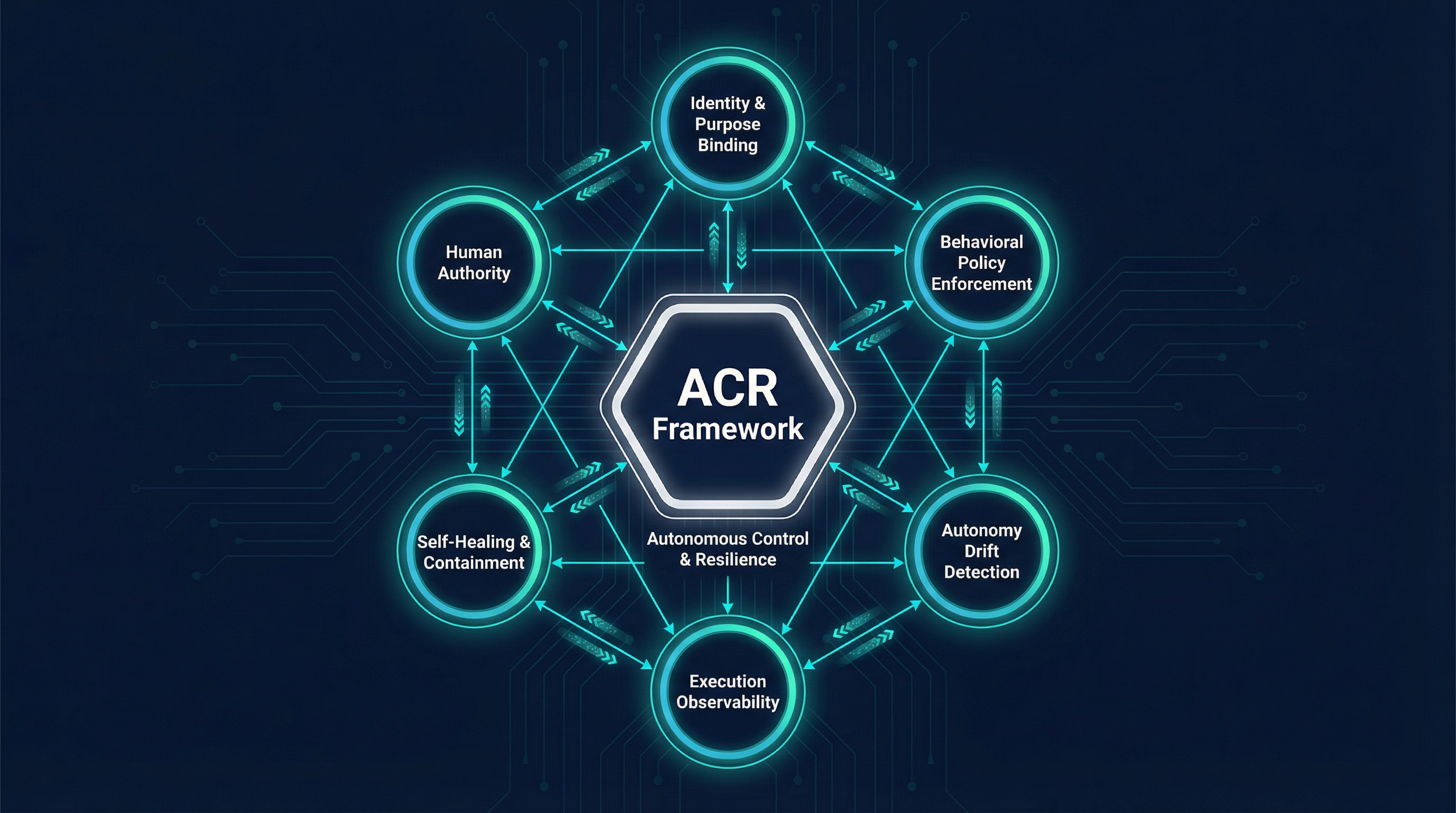
A runtime governance architecture for controlling autonomous AI systems in enterprise environments.
The standard introduces six operational control layers.
Identity and Purpose Binding
Every AI system should operate with a clearly defined identity and purpose.
Models should not exist as anonymous utilities. They should be bound to:
- specific functions
- authorized data sources
- defined operational boundaries
Without identity and purpose binding, oversight becomes impossible.
Behavioral Policy Enforcement
Governance policies must translate into machine-enforceable rules.
This means defining boundaries around:
- data access
- tool usage
- output behavior
- operational permissions
The goal is not simply to document acceptable behavior but to ensure systems cannot operate outside of those constraints.
Autonomy Drift Detection
AI systems evolve.
Prompt structures change. Workflows expand. Agents gain access to additional tools and data.
Without monitoring, these changes can lead to autonomy drift, where systems gradually move beyond their original governance boundaries.
ACR emphasizes continuous monitoring to detect when AI behavior deviates from its intended design.
Execution Observability
One of the most overlooked aspects of AI governance is the ability to observe execution in real time.
Security teams are accustomed to monitoring networks, endpoints, and cloud environments.
But most organizations have limited visibility into:
- how AI systems process inputs
- how decisions are generated
- what outputs are produced
Execution observability ensures that AI actions can be inspected, analyzed, and audited.
Self-Healing & Containment
When AI systems behave unexpectedly, organizations need automated containment mechanisms.
Self-healing capabilities allow systems to:
- detect anomalous behavior patterns
- automatically limit blast radius
- roll back to known-good states
- isolate compromised components
Containment reduces the damage potential of misaligned or compromised AI systems before human intervention occurs.
Human Authority
Finally, autonomous systems must operate within structures that preserve human authority.
This does not mean humans review every output.
It means that organizations maintain the ability to:
- intervene when systems behave unexpectedly
- pause or contain AI workflows
- enforce escalation for high-risk decisions
Autonomy should always exist within defined human oversight boundaries.
The Emerging Role of the CISO
As AI becomes operational infrastructure, governance responsibilities are increasingly converging within the security function.
Historically, security leaders focused on protecting systems and data.
Today, they are also being asked to govern algorithmic behavior.
This shift is redefining the CISO's role.
Security teams are now responsible for helping organizations answer questions like:
- How do we control AI decision systems?
- How do we audit AI-generated outcomes?
- How do we prevent AI systems from operating outside policy?
These are not traditional cybersecurity problems.
But they are rapidly becoming security leadership problems.
The Next Phase of AI Governance
The organizations that succeed in this next phase will not be the ones with the most comprehensive policy documents.
They will be the ones that build the technical infrastructure necessary to enforce those policies.
AI governance is entering its enforcement era.
And as autonomous systems become embedded in enterprise operations, governance will increasingly depend on the ability to control those systems in real time.
Policy defined the first phase of AI governance.
Runtime control will define the next.
About the ACR Standard
The ACR Standard (Autonomous Control & Resilience) is an operational architecture for governing autonomous AI systems in enterprise environments.
Unlike traditional AI governance approaches that rely primarily on policy documentation, ACR focuses on runtime control, behavioral enforcement, and decision observability.
The ACR Standard was developed to help organizations maintain control over increasingly autonomous AI systems operating across enterprise infrastructure. Learn more at runtimecontrol.io →
Get the free ACR Governance Toolkit — assess your maturity, classify agent risk, and test your incident response.
Want more governance insights?